AI-Powered URL Shorteners: Revolutionizing Link Management (2025 Guide)
The world of link management is evolving rapidly thanks to artificial intelligence. Traditional URL shorteners simply compress long links, but AI-powered URL shorteners add a new layer of intelligence that's revolutionizing how marketers and businesses approach digital campaigns. By analyzing link content and click data, these tools can predict link performance, automate optimization, and even generate smart link names.
Marketers now have access to predictive analytics that offer deep insights into user behavior and campaign performance through AI-augmented shortening services. In short, AI-driven link platforms are no longer just redirecting traffic—they are helping shape smarter, data-driven marketing strategies. This comprehensive guide explores how AI is transforming URL shortening from a simple utility into an intelligent marketing powerhouse.
Smart Link Naming with AI
One of the most frustrating aspects of traditional URL shorteners has always been naming. Choosing a memorable, on-brand short URL can be challenging, especially when random strings are the default. This is where AI is making its first major impact.
How AI Generates Intelligent Link Names
Modern tools use machine learning to automate the naming process entirely. For instance, the Shrinkify platform includes an "AI slug generator" specifically designed to solve what they call "the hardest problem" in link management—naming. Dedicated AI models analyze the original page content and suggest meaningful, human-readable suffixes for short URLs.
The startup URLcut.ai has positioned itself as the only shortener that "reads your page content" to propose "meaningful, memorable URL slugs" instead of random characters. Meanwhile, platforms like Dub emphasize "AI-powered URL slug suggestions" as a core feature, showing how central this capability has become to modern link management.
The AI Naming Process
The technology behind smart link naming follows a sophisticated workflow:
Content Analysis: AI scrapes the target page, extracting the title, keywords, meta descriptions, and main topics to understand what the content is actually about.
Smart Suggestions: The model then proposes several short-link options or keywords that fit the content naturally. These suggestions are contextually relevant and capture the essence of the destination page.
Unique & Branded: AI ensures each slug is unique (avoiding conflicts with existing links) and, if desired, can be aligned with a brand's style guidelines or keyword preferences.
By automating link naming, AI frees marketers from guesswork and trial-and-error. Instead of arbitrary codes like bit.ly/xYz123, users get short links like mybrand.co/awesome-offer that boost trust and click-through rates. As Shrinkify's founder notes, AI naming "actually solves a problem" about link performance and naming that has plagued marketers for years.
Predictive Analytics for Link Performance
Perhaps the most revolutionary aspect of AI-powered URL shorteners is predictive analytics. Traditional shorteners tell you what happened after the fact—how many clicks you got, where they came from, what devices were used. AI-powered platforms tell you what's going to happen before you even launch.
From Reporting to Forecasting
Advanced platforms train machine learning models on historical click data and audience behavior to predict which links will get more attention. LinkDrip explains that AI-driven shorteners "embed advanced algorithms to provide predictive insights into how and when users are likely to engage." These tools can forecast future clicks or conversion probability for each link, letting marketers prioritize high-potential campaigns and adjust low-performers before wasting budget.
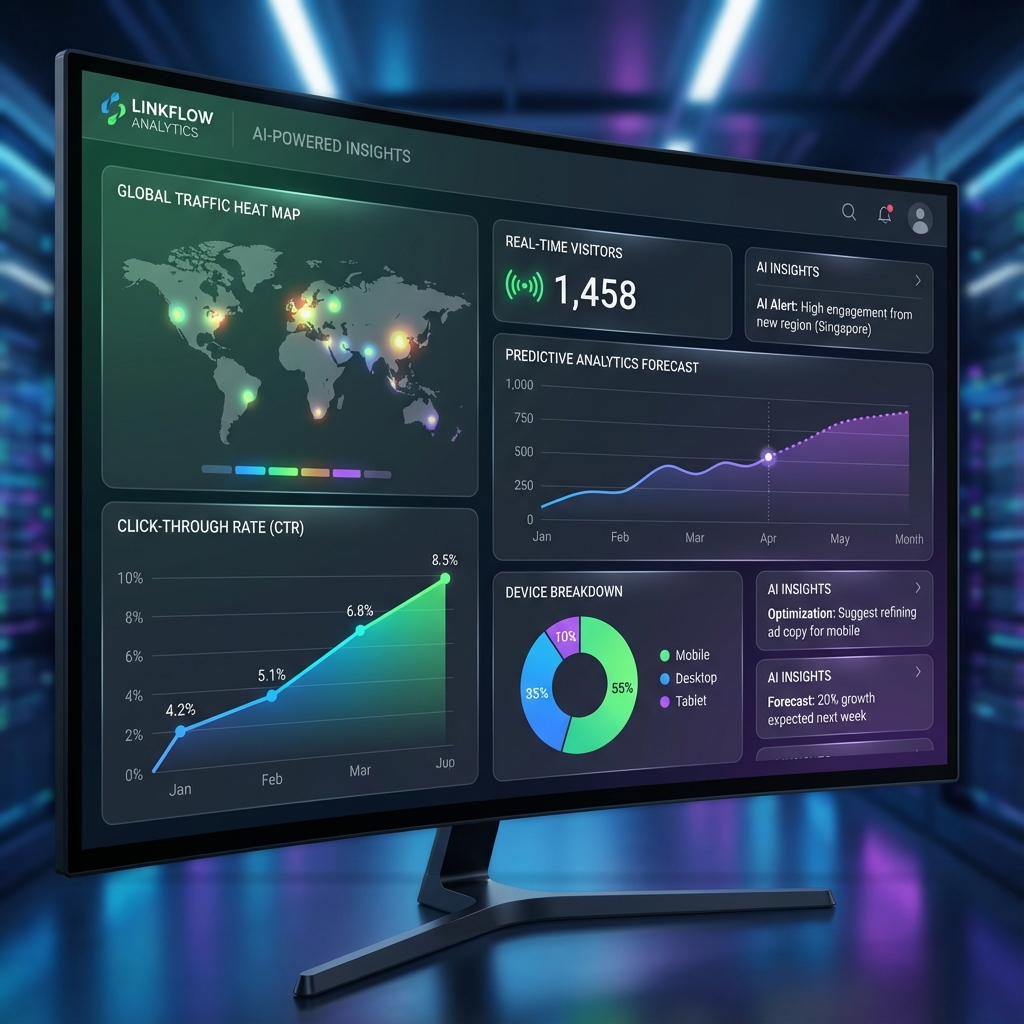 AI-driven link tools provide deep analytics dashboards. Many AI shorteners build predictive forecasting and recommendations directly into these interfaces.
What AI Can Predict
Specifically, AI models deployed in modern link management platforms can:
Forecast Click Trends: Machine learning analyzes past link performance to predict future engagement over specific time periods—typically 7-day, 30-day, or 90-day forecasts. This helps planners anticipate traffic spikes or declines and adjust campaigns accordingly.
Link Scoring: Some systems assign a predictive "link score" to a new URL based on multiple factors—anchor text, page type, audience segment, and historical patterns. A higher score means the link is statistically likely to perform well, helping marketers prioritize which links to promote heavily.
Real-Time Insights: AI continuously monitors live traffic patterns. It can spot emerging trends, such as a sudden surge from a particular geographic region or social channel, allowing marketers to react immediately and capitalize on momentum.
For example, BetterLinks (a WordPress link manager with AI capabilities) notes that its AI can "predict potential performance" by training on past clicks and assigning predictive link scores. LinkDrip similarly highlights how AI analytics let marketers "optimize their campaigns" by comparing forecasted outcomes against actual results.
In practice, this means if an AI predicts that a certain post's link will underperform, you can adjust the copy, placement, or targeting in advance—saving time and advertising spend. As one industry analysis explains, AI in link management turns link shortening into "proactive rather than reactive" marketing.
Automated A/B Testing and Optimization
AI is also transforming how marketers test and optimize their links. Traditionally, A/B testing required manual setup: create two versions of a link, split traffic 50/50, wait for statistical significance, then manually implement the winner. This process could take weeks and required constant monitoring.
How AI Automates Split Testing
Modern AI-powered link platforms streamline this entire workflow. Many tools now allow rotating destination URLs behind a single short link. A service like LinkTrackr automatically sends more traffic to the better-performing variant, essentially running a continuous, self-optimizing A/B test without human intervention.
Split Testing Made Simple: Tools like LinkTrackr let you "rotate multiple destination URLs behind a single link" to test different landing pages, offers, or creative variations. The system then automatically favors the link version with higher conversions, eliminating manual traffic allocation.
AI-Driven Optimization: Newer AI-centric platforms take this concept further. By analyzing click and conversion data in real time, they can automatically adjust A/B tests on the fly. For example, BetterLinks notes that marketers can use "AI-powered tools to perform A/B testing" on links, making real-time performance adjustments based on emerging patterns.
Fast Iterations: With machine intelligence handling the analysis, tests can run more quickly and efficiently. The AI can simultaneously compare multiple link variations and redirect traffic toward the most engaging content, dramatically shortening test cycles and accelerating campaign optimization.
The Self-Tuning Link
Ultimately, automated A/B testing frees marketing teams from manual optimization drudgery. Rather than sifting through spreadsheets and making incremental adjustments, AI link tools handle the heavy lifting. As LinkDrip puts it, AI lets marketers "compare multiple link configurations to determine which ones yield the highest engagement," effectively speeding up campaign refinement by 10x or more.
In essence, AI link managers turn split-testing into a self-tuning process, continually routing users to the best-performing content without requiring human decision-making at every step.
Leading AI-Powered Link Management Tools
The market for AI-driven URL shorteners has exploded over the past year, with several platforms pioneering innovative features. Here's a comprehensive look at the tools leading this revolution:
Shrinkify
A newcomer explicitly built around AI from the ground up. Shrinkify uses GPT-4 and other advanced models to power features like conversational analytics (ask plain-English questions about your clicks) and predictive forecasts. The platform's free tier includes basic AI link management, while premium plans unlock "all AI features," illustrating its AI-first philosophy.
What sets Shrinkify apart is its focus on making AI accessible. You don't need to understand machine learning—you just ask questions like "How are my links performing this week?" and the AI responds with actionable insights.
Dub
Highlighted by Zapier as a "super modern link shortener," Dub offers AI-powered URL slug suggestions alongside features like advanced geotargeting and comprehensive analytics. Dub's integration with Zapier makes it part of larger AI workflows—for example, automatically generating optimized links when new content is published to your CMS.
Dub represents the new generation of link shorteners that treat AI as a core feature rather than an add-on, making intelligent link management accessible to teams of all sizes.
URLcut.ai
This platform emphasizes AI page analysis above all else. URLcut "actually reads your page content" to suggest smart slugs using natural language processing. Unlike older services that generate random codes, URLcut uses NLP to make each link descriptive and contextually relevant. Their marketing emphasizes that short links are "not only shorter—they're smarter."
LinkDrip
Beyond comprehensive documentation, LinkDrip is an AI-savvy link analytics service that provides detailed click tracking and uses AI to segment audiences and personalize links. Their case studies show how predictive analytics can double click-through rates by optimizing link placement and timing based on AI recommendations.
BetterLinks
A WordPress plugin focusing on link management with integrated AI features. BetterLinks can auto-detect broken links, suggest SEO-friendly slugs, and handle automated link redirects. The platform notes that their AI "fixes redirect chains" automatically and can predict link success before you even publish.
Comparison with Traditional Services
By contrast, legacy services like Bitly or Rebrandly still lead in raw popularity but offer mostly traditional analytics—click counts, referrers, device types. They have powerful dashboards and custom domain support, but the newest wave of startups is embedding AI at every step of the workflow.
For example, Bitly's integration with Zapier can incorporate some AI capabilities through third-party automation, but this is an add-on to a mostly conventional system. The most innovative platforms, however, natively build AI into the core workflow of naming, analytics, and optimization.
Each tool has its niche. LinkTrackr excels for affiliate marketers needing sophisticated split testing. Sniply focuses on adding call-to-actions to shared content. But the cutting-edge AI-powered tools stand out by automating tasks that used to require extensive manual analysis and educated guesswork.
Spotlight on LinkShrink.biz
In this evolving landscape of AI-powered link management, LinkShrink.biz represents an interesting position—a fast, free URL shortener that's building toward AI capabilities while maintaining its core promise of simplicity.
Current Capabilities
LinkShrink positions itself as a no-friction solution: you can paste a long URL and get a clean short link instantly, with "no sign up, no credit card required." The site highlights instant URL shortening and promises a simple, reliable experience: "Shrink, share, and track your links in seconds."
Thousands of users trust LinkShrink for fast, reliable, and free URL shortening. This user-friendly approach makes it attractive for individuals or teams who want quick link creation without complex setup or mandatory account registration.
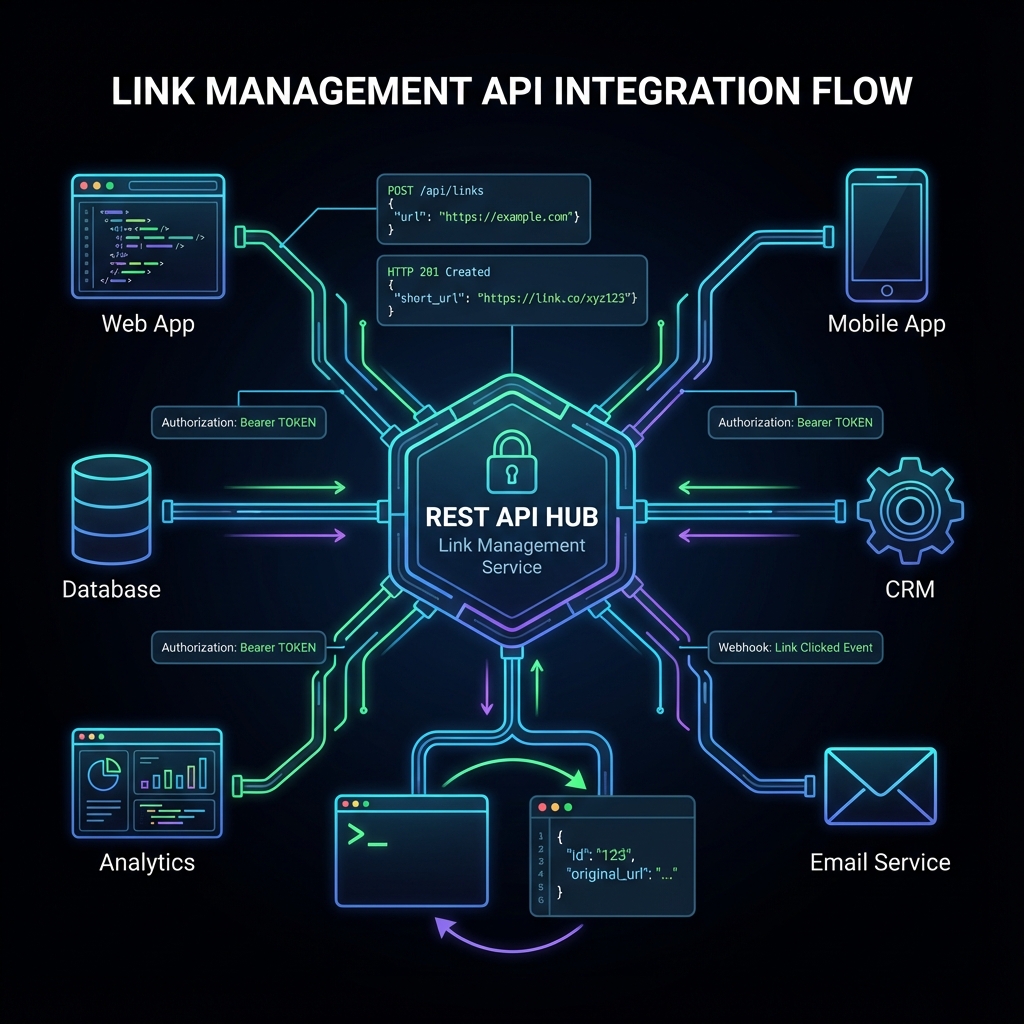 Developers can integrate link services via APIs. LinkShrink plans to offer a REST API for creating links and fetching analytics, supporting automation and custom workflows common in modern link management.
The Future of LinkShrink
LinkShrink's feature set is actively growing. While its core is instant URL shortening, the roadmap includes analytics and customization tools. The site advertises "advanced analytics" for tracking click geography and referrals coming soon for premium users, as well as custom branded links.
Most notably, LinkShrink is developing a developer-friendly REST API. Once available, teams could automate link creation and retrieve performance data via code—essential infrastructure for AI-powered integrations and automated workflows.
Positioning in the AI Landscape
In the landscape of AI link tools, LinkShrink.biz currently plays the role of a simple, no-frills shortener with future-oriented architecture. It isn't yet touting proprietary AI algorithms, but it supports the same fundamental goals: making links easier to use, monitor, and optimize.
Compared to premium AI-driven services, LinkShrink's advantage is accessibility—it's free and requires no account. Its pending features like analytics and APIs align with what marketers expect from smart link tools. As such, LinkShrink could appeal to users who need reliable, straightforward shortening now and may adopt more advanced AI features as the platform evolves.
The company's philosophy seems to be building the infrastructure first—API access, analytics, custom domains—which would provide the foundation for AI features like predictive analytics and smart naming in future releases.
Use Cases for AI-Powered Link Management
Understanding when and how to leverage AI link shorteners can dramatically improve your marketing results. Here are the scenarios where AI-powered features deliver the most value:
1. Enterprise Marketing Campaigns
Large marketing teams running dozens or hundreds of campaigns simultaneously benefit enormously from AI prediction and automation. Instead of manually monitoring each link, AI forecasts which campaigns will succeed and automatically optimizes underperformers.
2. Content Marketing and SEO
Content marketers creating evergreen articles can use AI to generate SEO-friendly short URLs that describe the content accurately. AI slug generation ensures each link is optimized for both users and search engines, improving click-through rates from search results.
3. Social Media Management
Social media managers juggling multiple platforms need links that perform well everywhere. AI can predict which link variations will perform best on Twitter versus LinkedIn versus Instagram, and automatically route traffic accordingly.
4. Affiliate Marketing at Scale
Affiliate marketers managing hundreds of product links benefit from AI's ability to score and rank links by predicted performance. Focus promotional efforts on the links AI predicts will convert best, maximizing ROI.
5. E-commerce and Product Launches
E-commerce teams launching new products can use AI A/B testing to automatically find the best combination of landing page, offer, and messaging—all behind a single, clean short link that updates in real-time.
The Technical Side: How AI Analyzes Links
For those curious about what's happening under the hood, here's a simplified explanation of how AI-powered link shorteners work:
Data Collection
The AI starts by collecting massive amounts of data—millions of clicks, conversions, bounce rates, time-on-page metrics, and contextual information like page content, titles, and meta descriptions.
Model Training
Machine learning models are trained on this historical data to identify patterns. The AI learns things like: "Links with certain keywords tend to get more clicks from mobile users" or "Landing pages with video content convert better when shared on social media."
Real-Time Analysis
When you create a new short link, the AI analyzes the destination page in real-time, extracting relevant features. It then compares these features against its trained models to generate predictions and suggestions.
Continuous Learning
The best AI systems continuously learn from new data. Every click on your links feeds back into the model, making future predictions more accurate. This creates a virtuous cycle where the AI gets smarter over time.
Privacy and Ethics in AI Link Management
As with any AI technology, privacy and ethical considerations are paramount. Reputable AI-powered link shorteners follow several best practices:
Data Minimization: Collecting only the data necessary for predictions, not harvesting excessive personal information about users or clickers.
Transparency: Being clear about what data is collected, how AI models are trained, and what predictions are being made.
User Control: Giving link creators control over their data, including the ability to delete links and associated analytics.
Bias Mitigation: Actively working to ensure AI models don't perpetuate biases or discriminate against certain audiences.
When choosing an AI-powered link shortener, look for providers that are transparent about their data practices and give you control over your information.
The Future of AI Link Management
Looking ahead, link management will only get smarter. The current generation of AI link tools already offers capabilities that seemed like science fiction just a few years ago. But we're only scratching the surface of what's possible.
Emerging Trends
Voice-Controlled Link Management: Imagine saying "Create a short link for my latest blog post and optimize it for Twitter" and having the AI handle everything.
Hyper-Personalization: AI that creates different destination URLs for different audience segments—all behind a single short link—based on factors like location, device, time of day, and browsing history.
Predictive Content Matching: AI that doesn't just predict link performance but actually suggests what content to create based on what your audience is most likely to click.
Blockchain Integration: Combining AI with blockchain for transparent, verifiable link analytics that can't be manipulated or faked.
Neural Network Optimization: Using deep learning to optimize not just which links perform best, but the entire user journey from click to conversion.
Democratization of Advanced Tools
Perhaps most exciting is how AI is democratizing advanced marketing capabilities. Tools that once required enterprise budgets and data science teams are now accessible to solo entrepreneurs and small businesses. A freelance marketer can now leverage the same predictive analytics as a Fortune 500 company.
Getting Started with AI Link Management
Ready to harness the power of AI for your link management? Here's a practical roadmap:
Step 1: Assess Your Needs
Start by understanding what you need from a link shortener. If you just need basic shortening for occasional social media posts, traditional tools (or even simple ones like LinkShrink) might suffice. But if you're running campaigns, doing affiliate marketing, or managing links at scale, AI features will provide significant ROI.
Step 2: Choose Your Platform
Based on your needs, select an AI-powered platform. Shrinkify is excellent for conversational analytics. Dub integrates well with automation tools. URLcut.ai excels at content-aware naming. Try a few to see which interface and feature set matches your workflow.
Step 3: Start Simple
Don't try to use every AI feature at once. Start with smart naming—let the AI suggest link slugs instead of using random strings. Get comfortable with that before diving into predictive analytics.
Step 4: Monitor and Learn
Pay attention to what the AI is telling you. If it consistently predicts that certain types of links will underperform, investigate why. Use these insights to improve your content strategy, not just your link strategy.
Step 5: Automate Gradually
As you become more comfortable, start automating more of your workflow. Set up automated A/B tests. Use API integrations to automatically create links when you publish content. Let the AI handle optimization while you focus on strategy.
Common Pitfalls to Avoid
Even with powerful AI tools, there are mistakes to avoid:
Over-Reliance on Predictions: AI predictions are probabilistic, not guaranteed. Always have a backup plan and don't bet everything on a prediction.
Ignoring the Data: The AI is only as good as the data it's trained on. If you're in a niche market, the AI might need time to learn your specific audience patterns.
Sacrificing Clarity for Cleverness: Just because the AI suggests a clever slug doesn't mean it's the right choice. Sometimes simple and descriptive beats creative and ambiguous.
Not Testing the AI's Suggestions: Particularly with new platforms, verify that the AI's suggestions align with your brand voice and marketing goals.
FAQ
Q: What makes AI-powered URL shorteners different from traditional ones? A: AI-powered shorteners go beyond simple link compression. They use machine learning to generate smart, memorable link names, predict link performance, automate A/B testing, and provide predictive analytics based on historical data and user behavior patterns.
Q: Can AI really predict which links will perform better? A: Yes. Advanced AI platforms analyze historical click data, audience behavior, and context to forecast engagement. They can predict click trends over 7-day, 30-day, or 90-day periods and assign performance scores to help marketers prioritize high-potential campaigns.
Q: Do I need technical expertise to use AI link management tools? A: Not at all. Modern AI-powered shorteners like Shrinkify and Dub are designed to be user-friendly. The AI works behind the scenes to automate complex tasks like naming, optimization, and analytics, making these advanced features accessible to everyone.
Q: Are AI-generated link names better than random strings? A: Absolutely. AI-generated names are meaningful, memorable, and descriptive. Instead of random codes like 'bit.ly/xYz123', you get branded links like 'mybrand.co/awesome-offer' that boost trust and click-through rates significantly.
Conclusion
AI is transforming link management from a simple utility into an intelligent marketing tool. By automating smart naming, predictive analytics, and A/B testing, AI-powered shorteners help teams squeeze maximum value out of every link. These systems turn raw click data into actionable forecasts: they ensure short URLs are meaningful, predict which campaigns will succeed, and automatically optimize traffic.
In effect, AI does the heavy lifting of data analysis, freeing marketers to focus on strategy and creativity. As more platforms integrate machine learning, we can expect even more advanced capabilities in the months and years ahead.
For anyone serious about digital marketing, exploring AI-powered link management tools is no longer optional—it's essential. From cutting-edge platforms like Shrinkify and Dub to accessible services like LinkShrink.biz building toward AI capabilities, there's a tool for every use case and budget.
The future of link management is intelligent, automated, and predictive. The question isn't whether to adopt AI-powered link tools—it's which one to start with and how quickly you can integrate them into your workflow. Start exploring today, and experience how data-driven links can boost engagement and ROI across all your digital marketing efforts.
Further Reading: